IoT
ESP32 - The Tiny Chip That Connects Everything
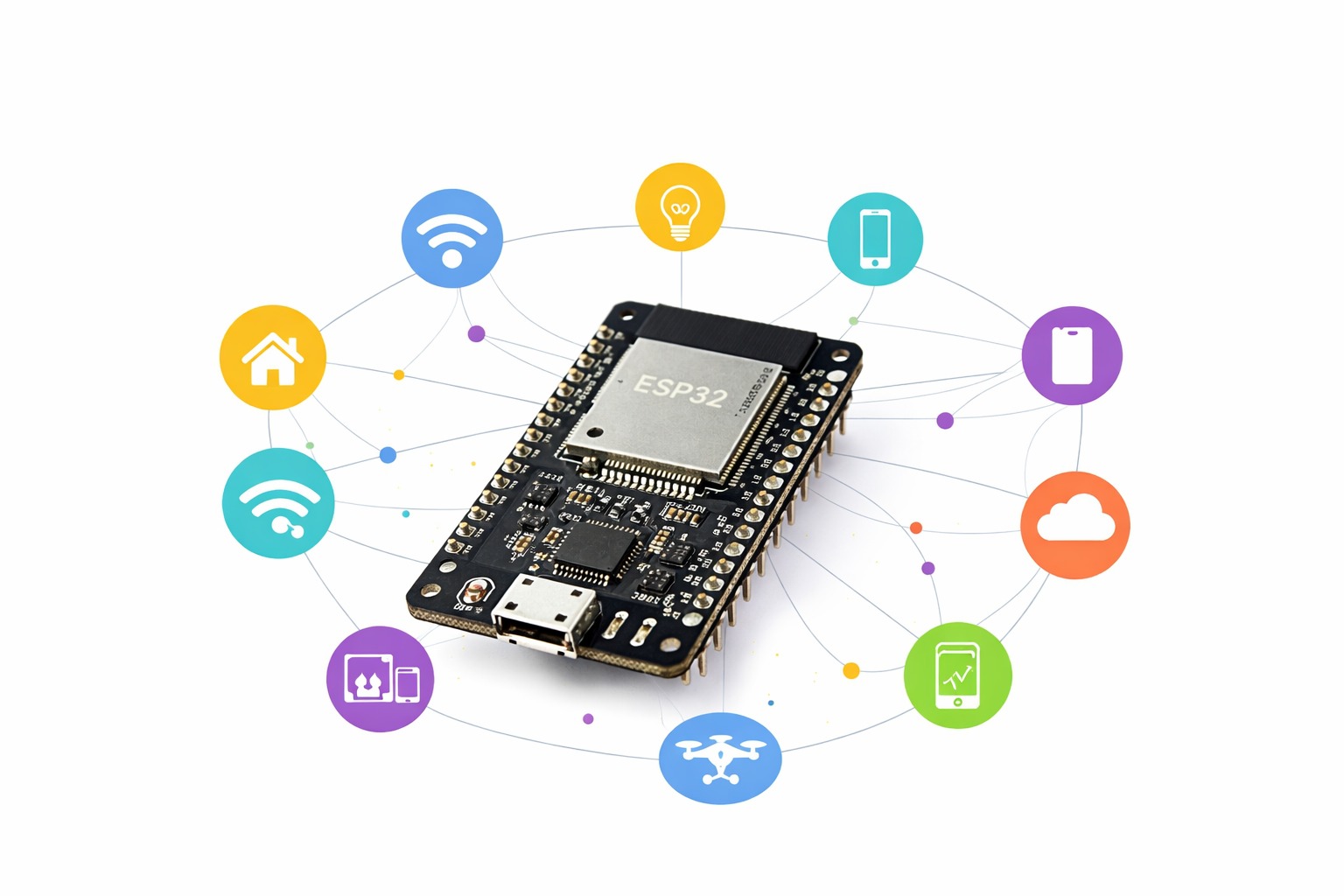
The ESP32 combines dual-core processing, built-in Wi-Fi, and Bluetooth in a low-cost board that powers everything from beginner smart devices to commercial IoT products.
Full Article
If you have spent any time in the world of electronics, IoT, or maker projects, you have almost certainly heard the name ESP32. And if you haven't - buckle up, because this little chip is about to change the way you think about what a microcontroller can do. Developed by Espressif Systems, a company based in Shanghai, the ESP32 was released in 2016 and almost immediately became the darling of the electronics community worldwide. The reason is simple: it packs an almost absurd amount of capability into a chip that costs less than a fast food meal. So What Exactly Is the ESP32? At its core, the ESP32 is a microcontroller - a small computer on a chip designed to run a single program and control hardware. But calling the ESP32 just a microcontroller is like calling a Swiss Army knife just a knife. What separates it from almost everything else at its price point is that it has Wi-Fi and Bluetooth built directly into the chip itself. No external modules. No AT commands. No extra wiring. You just write your code, call a few functions, and your device is on the internet. The processor inside is a dual-core Xtensa LX6 running at up to 240 MHz. Having two cores means the ESP32 can do two things at once - typically, one core handles the Wi-Fi and Bluetooth radio stack while the other runs your actual application. This separation means your program does not slow down or hiccup every time a Wi-Fi packet is sent or received. The chip has 520 KB of SRAM (working memory) and most development modules ship with 4 MB of flash storage for your program code. The Wireless Capabilities Are Genuinely Impressive Let's talk about the Wi-Fi because this is where the ESP32 really earns its reputation. It supports 802.11 b/g/n on the 2.4 GHz band and can operate in three modes simultaneously if needed: Station mode (connecting to your home router like any device), Access Point mode (acting as a router itself, creating its own Wi-Fi network), and a combined Station + AP mode. This last mode is particularly useful for configuration - the device creates a hotspot, you connect to it from your phone to enter your home Wi-Fi credentials, and then it switches to station mode and connects to your router. Clean, professional, and no hardcoded passwords. Beyond standard Wi-Fi, Espressif also built their own peer-to-peer protocol called ESP-NOW. This lets multiple ESP32 boards talk directly to each other without any router in the middle - with latency under 1 millisecond. It is perfect for wireless sensor networks, remote controls, and mesh setups in places where a router is not available. On the Bluetooth side, the ESP32 supports both Classic Bluetooth 4.2 and BLE (Bluetooth Low Energy). This means it can act as a Bluetooth speaker receiver, connect to your phone as a BLE peripheral, track nearby BLE devices, or broadcast beacon signals - all without any external hardware. GPIO Pins That Do Far More Than On and Off The ESP32 exposes 34 GPIO (General Purpose Input/Output) pins, and almost every single one of them is multifunctional. Pins can be configured as digital input/output, PWM output (for dimming LEDs or controlling motors), ADC input (for reading analog sensors with 12-bit resolution - that is 4096 steps of precision), DAC output (true analog voltage output, rare at this price), or capacitive touch sensor. Ten of the GPIO pins can detect a human touch through a wire or copper pad - no additional sensor chip required. For communication, the ESP32 supports SPI, I2C, I2S (digital audio), UART, CAN bus, and even an SD card interface. You can connect an OLED display, a temperature sensor, a microSD card, and a motor driver all at the same time on a single ESP32 - and still have pins left over. Programming Options for Every Skill Level One of the smartest things Espressif did was make the ESP32 fully compatible with the Arduino IDE. If you already know how to program an Arduino Uno, you can program an ESP32 today - just install the ESP32 board package, select your board, and upload. The same digitalWrite(), analogRead(), and Serial.println() functions you already know work exactly as expected. For more advanced developers, Espressif provides the ESP-IDF (IoT Development Framework) - a professional C-based SDK with full access to every hardware peripheral, FreeRTOS task scheduling, and power management APIs. If you are building a commercial product, ESP-IDF is the way to go. MicroPython is another option - you can write Python directly on the ESP32, interact with it through a REPL over serial or Wi-Fi, and prototype extremely fast without a compile step. For educators and beginners coming from a Python background, this is an excellent entry point. Power Management That Makes Battery Projects Viable The ESP32 has a sophisticated deep sleep mode that brings power consumption down to around 10 microamps. In deep sleep, almost everything shuts off - but the ESP32 can be configured to wake up on a timer, a GPIO pin change, or even a touch input. A practical example: an ESP32 in deep sleep, waking every 10 minutes to read a temperature sensor and post the value to a cloud dashboard, can run for six to twelve months on a single 18650 lithium battery. This makes the ESP32 genuinely viable for field-deployed, battery-powered sensors - something most people would not expect from a Wi-Fi capable device. Who Is the ESP32 For? Honestly? Almost everyone. If you are a beginner who wants to build a smart home device, a weather station that posts to the internet, or a Bluetooth-controlled robot - the ESP32 is your board. If you are an intermediate maker building a product prototype or a multi-node IoT sensor network - the ESP32 is your board. If you are a professional engineer evaluating platforms for a connected consumer product - Espressif's ESP32-S3 or ESP32-C3 variants are in millions of commercial products worldwide. At $3 to $8 for a complete development board with USB interface, the ESP32 is the best value in electronics today, full stop.
Key takeaway: For connected hardware at an accessible budget, ESP32 offers one of the best performance-to-price ratios available.